The Kerb Is a Kitchen: Starting a Street Herb Patch This Winter
On a damp November morning, the strip between the pavement and the road looks like little more than mud, dog-walking margin and the occasional crisp packet. But look again. It is south-facing more often than you think. It collects rain. It is walked past twenty times a day. With a modest, lawful nudge, that forgotten verge can become a pavement pantry: a shared herb garden that gives the street rosemary for a roast, thyme for a tray of roots, and a reason to say hello.
This is not about grand designs. It is about a small act of public-space permaculture that begins with a conversation and ends with a laminated sign and a rota that actually works.
First, work out whose dirt it is
Most urban verges are highway land, managed by the local council. Do not assume that because it is scruffy nobody owns it. Start with the council's website, then ring the highways team and ask who manages the verge outside your house. Some councils run adopt-a-verge or community planting schemes; others will say no to digging but yes to moveable planters. Ask for the answer in writing, even if it is an email.
If the verge is council land, explain what you want to do: low-growing culinary herbs, no barrier to sightlines, no trip hazards, a simple maintenance plan. Talk to your ward councillor too. They can be surprisingly useful translators between residents and highways officers.
If permission is slow or refused, do not dig. Use containers instead. A row of robust pots along a wall, or a couple of half-barrels on a paved frontage, can do the same social work without touching the highway. The point is the shared harvest, not the rebellion.
And do not skip the neighbours. A note through the door, a chat on the step, a quick ask in the street WhatsApp group: this is the real planning permission. Someone will worry about rats, someone else will offer a spare watering can, and one person will tell you the verge floods every January. All of that is useful.
Choose herbs that forgive neglect
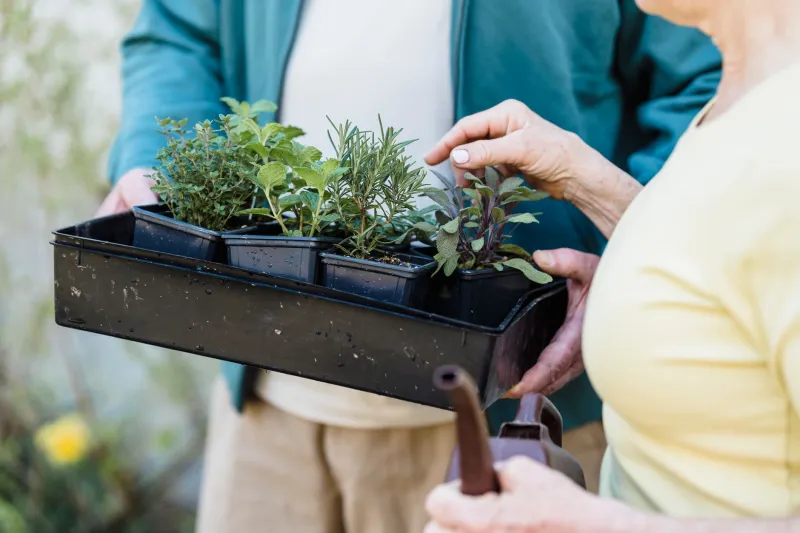
A pavement herb patch needs plants that can cope with UK winters, poor soil, occasional trampling and the sort of neglect that comes from everyone being busy. Think rosemary, thyme, sage, oregano, chives and winter savory. These are tough, useful and mostly evergreen enough to earn their space. Mint is brilliant but bossy, so keep it in a sunken pot unless you want the whole verge to become a mint monopoly. Lemon balm is lovely and medicinal, but it is in the mint family for a reason.
For a little medicinal colour, add calendula and chamomile at the front, where they can be picked for teas and balms. They are annuals or short-lived, so treat them as a bonus rather than the backbone. In November, the soil is often too cold and wet for much planting, so use this month to plan, clear rubbish, improve drainage and speak to the council. Plant hardy perennial herbs in early spring once the worst of the wet is past, or plant now if you have a sheltered, free-draining spot and healthy plants waiting in pots.
Use peat-free compost and a mulch of leaf mould or well-rotted bark. Do not enrich the soil too much: herbs like thyme and rosemary prefer leaner, sharper conditions and will flop and sulk in rich compost. Right plant, right place, right amount of neglect.
Build small, visible and safe
Start with one stretch, not the whole street. Keep the verge clear of the kerb edge so nothing obstructs the road or pavement. Avoid tall plants that block sightlines at corners. Do not plant over utility covers or root into cracks where you might damage services. If you are using containers, choose heavy ones that will not blow over, and raise them slightly so winter rain can drain.
A simple sign does a lot of work: “Street herb patch — pick a sprig, leave the crown.” Add a QR code to a shared calendar if you are feeling fancy, but a laminated notice with a phone number is enough. The sign is not just information; it is an invitation and a gentle social contract.
A rota that is not a second job
The difference between a thriving shared herb garden and a sad collection of thyme in a puddle is usually not money. It is a rota. Keep it light. Two households per month, not one heroic person forever. Their jobs are simple: water in dry spells, pull obvious weeds, remove litter, trim spent flowers, and report anything broken in the group chat.
In winter, the rota is mostly about observation: is the verge waterlogged? Has a pot cracked? Is the sign still there? In spring, it is planting and mulching. In summer, it is harvesting and deadheading. In autumn, it is cutting back and dividing. Put the rota in a calendar that everyone can see, and rotate the months so no one carries the whole thing.
Harvest rules should be equally clear: take a sprig, not a shrub. Leave the crown. Pick from the outside. Never strip a plant bare. If someone wants a big bunch for a community meal, ask first. That way the patch belongs to the street rather than to the fastest picker.
The harvest is mostly social
A pavement herb garden will not feed the street. It might give you a handful of herbs a week in summer, and that is fine. Its real yield is the conversation when someone stops to ask what the rosemary is for, the child who learns that chives taste of onion, the older neighbour who remembers a herb bed that used to be there in the 1970s. It changes the street's idea of itself, from a corridor of bins into a place with a shared larder.
So start this weekend. Walk your street and find the scruffiest, sunniest verge. Work out who owns it. Knock on two doors. Choose three tough herbs. Draw a tiny plan. If the answer is yes, plant in spring 2027 with a sign and a rota. If the answer is no, put a pot by your gate and share that instead. The kerb is a kitchen, but only if we treat it like one together.