The Cutting Season: A Winter Scion Swap for Your Street's Best Apple
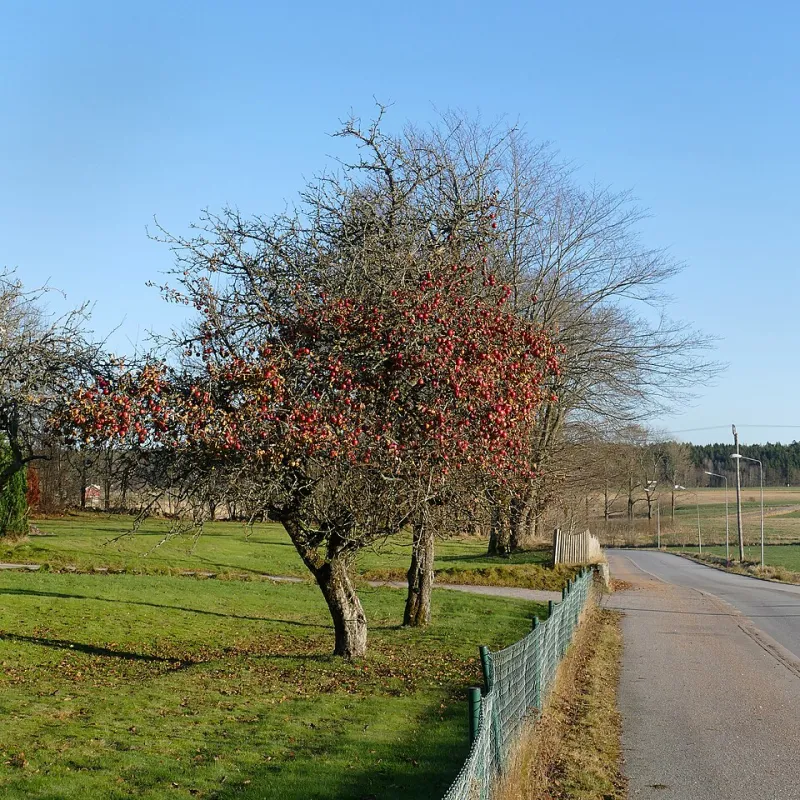
Photo: W.carter, CC BY-SA 4.0, via Wikimedia Commons
There is a tree at the end of a nearby street that produces apples so crisp and sharp they make the supermarket aisle feel like a rumour. You have walked past it for years. You have probably taken a bite over the fence and said, vaguely, that you must find out what it is. This winter, before grafting season arrives, that tree can become more than a good snack. It can become a scion swap.
Scionwood is simply this year’s dormant growth, cut from a tree you want to copy. Grafted onto a rootstock, it becomes a new tree with the same fruit as the parent. One good apple, a sharp knife and a room full of neighbours with labelled sticks can turn a single street tree into a small orchard. The trick is doing it with permission, clean cuts and the kind of labelling that survives a damp January pocket.
Ask first — and ask properly
Start with the obvious courtesy: permission. If the tree is in someone’s front garden, knock on the door. Explain what you want, why you want it and how little you plan to take. Most people are pleased that their tree is admired. Some are baffled. Either reaction is fine; what matters is that you do not help yourself to other people’s branches.
For street trees, allotment trees and trees in communal gardens, find out who manages them. Councils often have tree officers, and many are more open to a polite request than people assume. Never cut from a tree you do not have permission to prune, and never take from a young tree that is still finding its shape. A mature, well-established tree can spare a few pencil-thin shoots. A newly planted one cannot.
It also helps to ask about the fruit. When does it ripen? How does it store? Is it a cooker, an eater or one of those useful dual-purpose apples? A photograph of the fruit, taken in autumn, is worth more than a guessed name. Local knowledge is not always tidy, but it is often accurate.
Read the tree before you cut
The best scionwood comes from last season’s growth: straight, firm shoots about the thickness of a pencil, with well-spaced buds. Avoid anything wrinkled, cankered, scabby or covered in woolly aphid. Avoid the very thin whippy growth at the top of the tree and the shaded, spindly shoots in the middle. You want wood that has had a decent summer, not a desperate one.
Look at the parent tree as a whole. A healthy apple or pear with clean bark, good extension growth and a sensible shape is worth copying. If it is struggling, full of canker or clearly diseased, leave it alone. You are not preserving a problem; you are selecting for vigour and health.
There is a quiet pleasure in this bit. You are not just taking cuttings. You are reading a neighbourhood tree closely enough to notice which branch grew well, which side caught the sun and which buds look plump enough to graft. That is the same observational habit we use on our own plots, just applied to a tree we do not own.
Cut, label, store: the pencil-thick rule
Wait for a dry, mild winter day, ideally between December and early February, before the buds begin to swell. Use clean, sharp secateurs. Take shoots 20–30cm long, with four to six buds, and make a straight cut at the base and an angled cut at the tip so you can remember which way up it goes. Bundle them loosely, label them immediately and keep them cool.
Aim to take only what you need. Two or three shoots from a healthy tree is plenty for a small swap. If several people want the same variety, coordinate so the tree is not stripped. A little restraint now leaves a better parent tree for next winter.
Storage is where good intentions often fail. Wrap the bundles in slightly damp paper, seal them in a labelled plastic bag and keep them in the fridge — not the freezer — at around 2–4°C. Check every few weeks for mould or drying. If the wood looks shrivelled, the paper was too dry; if it is furry, it was too wet. The label should include the variety, the date, the location and the donor’s name. “Apple, nice one, Dave’s road” is not a label; it is a riddle.
Make the swap more than a table of sticks
A scion swap can be as simple as a few neighbours meeting in a pub back room with bundles of labelled wood, a roll of masking tape and a pot of tea. But the best ones teach something. Ask an experienced grafter to demonstrate a whip-and-tongue cut on a spare rootstock. Have a table for rootstock orders so people can buy a handful of M26 or MM106 together and split the postage. Put out a few books or printed guides on apple varieties. Keep it short and sociable.
Libraries, community halls, allotment huts and church rooms all work well. Avoid anywhere too warm or too dry, because scionwood hates being treated like a radiator. Bring labels, permanent markers, elastic bands and clean bags. Ask people to bring notes on the parent tree — fruit colour, ripening time, storage quality, whether it cooks down to fluff or holds its shape. That information is half the value of the swap.
Why local varieties are worth the fuss
We are not talking about turning every street into a heritage orchard museum. The point is simpler: a tree that has fruited well in your area, without much fuss, is already adapted to local soil, shelter and climate. It may not be a named variety at all. It may be an old seedling that someone’s grandfather liked. But if it crops reliably and tastes good, it has pedigree enough.
Community scion swaps preserve that knowledge in a practical way. They also teach a skill that cannot be bought: grafting. Once you can join a scion to a rootstock, one tree becomes many. A neighbour’s good pear, an allotment society’s old cooker, a community orchard’s disease-resistant apple — all become available to more people without digging anything up.
Rootstocks and varieties for UK plots
For apples, M9 keeps trees small and productive but needs good soil and support. M26 is a useful middle ground for gardens and allotments. MM106 makes a larger tree for grassier sites, and M25 is for those who really do want a proper orchard tree. For pears, Quince A is the common semi-vigorous choice, while Quince C keeps things smaller. Order rootstocks in late winter for delivery before grafting, and store them heeled in or in damp compost if the weather turns.
Variety choice should follow taste and place, not fashion. ‘Egremont Russet’ and ‘Ashmead’s Kernel’ are superb eaters with real character. ‘Bramley’ is the classic cooker. ‘Discovery’ ripens early and makes a cheerful garden tree. ‘Cox’s Orange Pippin’ is wonderful but fussier in cool, wet spots. For pears, ‘Conference’ is reliable and ‘Doyenne du Comice’ is the luxury option where shelter allows. Ask at the swap what works locally; that is better than any catalogue.
After the swap: keep the thread going
Once the bundles are home, keep them cool and damp until grafting. Late February to early April is the usual window in most of the UK, depending on the weather and the rootstock. Label the grafted trees twice — once on the pot and once on a buried tag — because labels fade and children move pots. Then keep the new trees watered, weed-free and safe from rabbits.
A scion swap is not really about sticks. It is about a street learning its own fruit, one good tree at a time. It is also a quiet sort of insurance: if the old tree is ever lost, its offspring are already growing in neighbouring gardens. That is a decent legacy for a winter morning with a flask and a pair of secateurs.