Counting Every Drop: How to Run a Water Budget on Your Plot This Winter
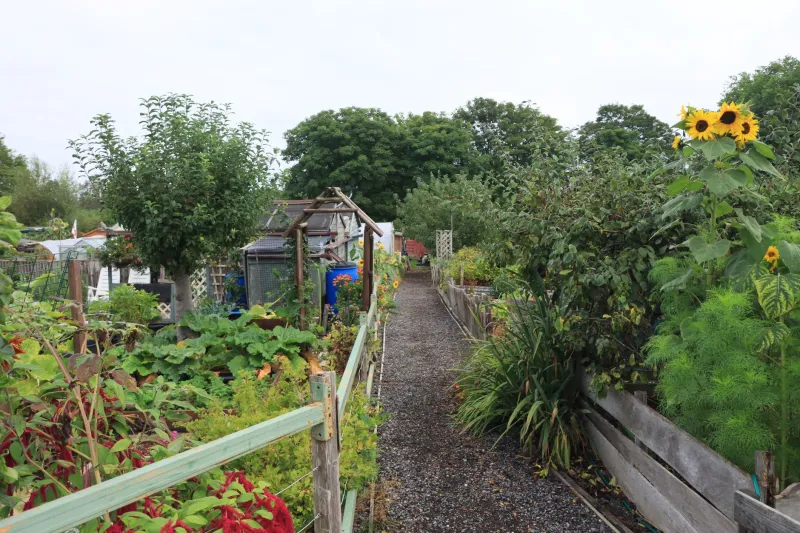
There's a particular kind of February morning at the allotment gate when the taps are off and everyone is quietly eyeing everybody else's water butt. The plot with the 1,000-litre stack is suddenly the richest address on site. It doesn't have to be that way, and the fix starts now, in the wettest month of the year, with a tape measure and a notebook.
Rainwater harvesting usually gets framed as a virtue: a nice thing to do, like recycling or taking the bus. But a warm feeling doesn't water a bed of courgettes in July. A budget does. And a budget means numbers – how much rain lands on your roof, how much you can realistically catch, how much your crops will drink, and how big the gap is when the two don't meet.
The arithmetic is embarrassingly simple, and almost every plot on almost every site is working with far less storage than its roofs could justify. Here's how to find out where you stand.
Why keep a water ledger at all
UK rainfall is getting more concentrated. Wetter winters, drier summers, and more of the annual total arriving in fewer, heavier downpours – that's the shape of the projections, and recent growing seasons have already given us a taste of it. Hosepipe restrictions have stopped feeling like a freak event and started to look like a fixture of high summer; water companies now publish drought plans well in advance, and 'temporary use ban' has entered the allotment vocabulary.
So the question isn't whether you approve of saving water. It's whether, on the week the ban lands, you have 600 litres under a downpipe or a queue at the standpipe. Treating rainwater as a ledger – measurable, forecastable, shareable – turns a vague worry into a schedule.
Start with the roof, not the butt
The single most useful fact in rainwater harvesting: 1mm of rain falling on 1m² of roof gives you 1 litre. Everything else is multiplication.
Measure the footprint of every roof you could plausibly plumb into a butt – shed, greenhouse, garage, porch, the flat roof over the bike store. A 3m × 2m shed is 6m². A 4m × 2.5m greenhouse is 10m². If you have 20m² of catchment in total, that's 20 litres for every millimetre that falls.
Then knock off a bit for reality. Splash, blocked gutters, the first flush that rinses the roof, and the overflow you can't capture all cost you something; a runoff coefficient of 0.8 to 0.9 is a fair working assumption for a guttered, pitched roof. At roughly 900mm of annual rain, 20m² of catchment at 0.85 gives you about 15,300 litres a year. That sounds like abundance. It isn't, because nearly all of it arrives between October and March, when your butts are already full.
Get a gauge on site rather than relying on an app. A cheap funnel gauge, or any straight-sided container with a ruler, read weekly and logged in a notebook, tells you what your plot actually receives – which on a windy site next to a hedge can be surprisingly different from the nearest official station. Log it through this winter and you'll have a local dataset of your own by spring.
What your crops are actually asking for
Here's where most water plans quietly collapse. A full summer canopy of vegetables transpires somewhere in the region of 3–5mm a day, which is 21–35mm a week – call it 25 litres per square metre per week to be practical. A single 10m² bed of beans or courgettes is therefore drinking around 250 litres a week in July. That's a whole standard water butt, per bed, per week.
Suddenly 'I've got a water butt' looks like what it is: a gesture. Two or three cubic metres of storage is a different proposition, and that's before you count greenhouse tomatoes, which want steady moisture and resent the hosepipe-and-forget approach.
Two things soften the numbers. Proper mulching – a good 5–8cm of compost, leafmould or straw – cuts evaporation from the soil surface considerably, and feeds the worms while it's at it. And watering deeply but less often, so moisture reaches down to where the roots are, beats a daily sprinkle that only wets the top centimetre and encourages shallow, thirsty rooting.
Sizing storage without buying more plastic
The useful sizing rule isn't 'match the annual rainfall', it's 'cover the longest dry spell your thirsty crops will face'. For most of us that's three or four weeks of peak summer demand. Two beds plus a greenhouse at 400 litres a week, over three weeks, is 1,200 litres – and that assumes the butts go into summer full, which means full by the end of March.
You don't need new plastic to get there. Food-grade IBCs turn up secondhand constantly; check the label or ask what they previously held, and give anything that carried chemicals a very wide berth. Old baths, lidded wheelie bins, redundant bulk containers from a friendly caterer and the subsidised butt schemes many water companies still run can all do the job. Linking butts in series with a bottom connector lets them fill and draw as one body of water, and raising them on pallets or a low frame gives you a watering-can's height of gravity – free pressure, no pump required.
Small upgrades pay for themselves. A downpipe diverter so the butt fills without you wrestling the pipe apart. A mesh guard and lid to keep leaves and mosquitoes out. An overflow routed to a swale, a fruit tree or a soakaway bed rather than straight down the drain. A bit of shading or a light-coloured wrap around the butt to slow the summer algal soup.
Sharing the surplus, planning for the gap
Water is the most shareable thing on a site. A communal tank near the gate, a rota for whoever tops it up, a group order of barrels, a group chat message that reads 'tank's full, help yourself' after a wet week in February. Seasoned plotholders will often let you harvest from a garage or extension roof that's currently doing nothing except soaking the lawn.
Be a good neighbour about it: ask before tapping anyone's downpipe, never cross-connect to the mains, and be straight about what you're taking. Then agree a drought plan in advance. Perennials, newly planted fruit trees, seedlings and anything in a pot come first; established shrubs, paths and grass can fend for themselves. Writing that priority order down now means you're not making panicky moral judgements at 8pm in a heatwave.
Your winter homework
November is the ideal month for all of this because the sky is doing the work for you. Walk the site with a tape measure and a notebook. Clear the gutters. Fit a diverter and a gauge. Start the rainfall log. Work out roughly how many litres each bed needs at peak, and how far short your storage falls. Then knock on three doors and ask what's above their shed.
By the time the first restriction notice of summer 2026 is pinned to the noticeboard, you'll know exactly what you're holding. That's the whole trick – not more plastic, just better accounting.