Your Plot Has Its Own Weather: A Weekend Survey of Slope, Aspect and Frost
November is the month when allotment advice gets repetitive. Find a south-facing spot. Pick a sheltered bed. Avoid the frost pocket. All sensible, as far as it goes — but most of us have never actually checked what our own ground is doing. We inherit a plot, squint at the sun, and repeat the rulebook back to ourselves. This winter, before the seed catalogues start their sales pitch, spend a weekend surveying the land you actually have. A compass, a spirit level and a few marker canes will tell you more than any generic guide.
South-facing is a direction, not a diagnosis
A south-facing slope receives more direct winter sun than a north-facing one, and that matters. Low winter light is precious. But aspect is only one variable in a messy, local system. A south-facing bed at the bottom of a slope can sit in cold air all night. A flat bed beside a wall can be warmer than a sloping one that drains freely. A plot that looks south on a map may be shaded by a neighbour's hedge from October to March.
The old rule is a starting point, not a finding. Your job is to test it against your own ground.
Start with a rough grid, not a grand plan
You do not need surveying qualifications. Push canes into the plot on a rough grid — say every three to four metres across the main growing area. Number them, or mark them with tape. If your plot is small, use fewer canes; if it is a half-allotment with raised beds, place one cane at each corner of each bed. The aim is not precision for its own sake. It is to stop yourself from generalising from the one spot where you always stand with a mug of tea.
At each cane, note three things: the aspect, the relative height and what the ground feels like underfoot. A phone compass is fine, but stand away from metal sheds and fences and take a couple of readings. Write down the direction the ground falls towards, not just the direction you face. Those are often different.
Find the cold rivers before they find your kale
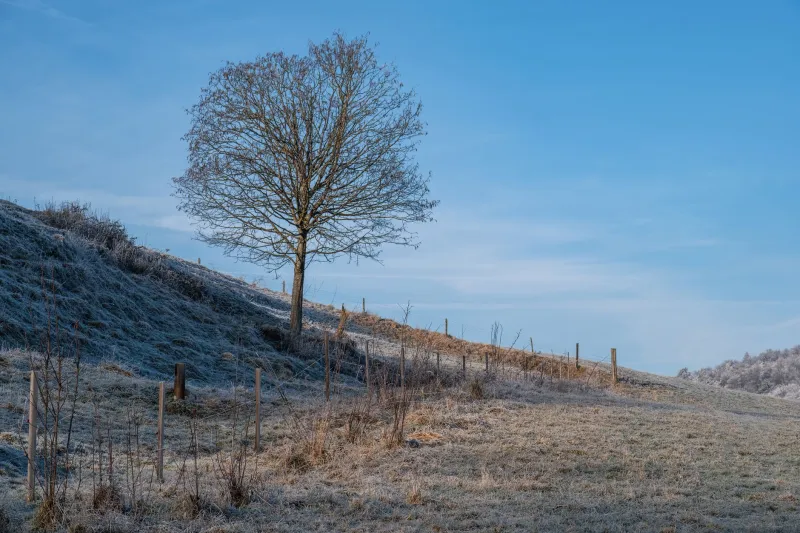
Cold air is heavy. On a still winter night it slides downhill, following the shape of the land, and pools behind barriers: hedges, walls, fences, sheds, even dense vegetation. That is why the lowest point of a plot is not automatically the most sheltered. It may be the coldest.
Walk the plot after a frosty night and look for the places where white lingers longest after sunrise. Check the bottoms of slopes, the inside corners of boundaries and any dip that holds water. Those are your frost pockets. Note them now, while the evidence is visible. A bed that grows brilliant summer courgettes can be a cruel place for winter salads.
Then look for the opposite: the spots that clear first. They are not always the highest. A slight rise, a free-draining soil and an open view to the low winter sun can warm a bed surprisingly early. That is your early-bed candidate for spring sowings and overwintered greens.
The spirit-level test: measuring gradient without drama
To measure slope, lay a straight two-metre batten on the ground, pointing downhill. Put a spirit level on top and lift the lower end until the bubble centres. Measure the gap between the batten and the soil at that end. A few centimetres over two metres is a gentle slope; a large gap is a steeper one. Repeat in a few directions. You are not producing an engineering drawing. You are finding out whether water lingers, whether soil washes, and whether cold air has a clear route down and away.
Gradient changes everything. A gentle south-facing slope may warm early but dry out fast in spring. A north-facing slope may be slower and colder, but it can hold moisture through a dry spell. A flat plot is not neutral either: it may drain poorly, or it may be the most stable place for winter crops. The point is to stop guessing.
Aspect, shade and the low winter sun
In winter the sun sits low. A hedge that is irrelevant in June can cast a long shadow in December. Stand at each cane and note what blocks the sun between roughly 10am and 2pm — the useful window for winter growth. A south-facing wall can store heat and release it slowly, but a south-facing bed behind a tall fence may get less light than a north-facing bed in the open.
This is where the best spot on paper often fails in practice. The planner's ideal is a sunny, sheltered, free-draining slope. The real plot may offer a clumsy compromise: a slightly raised bed near a path, with morning sun and a clear run for cold air. That is not a consolation prize. It is evidence.
Turn the survey into a working map
Back indoors, sketch the plot and mark four things: cold pools, early-warming beds, wet spots and wind funnels. Add the canes as reference points. Keep the map rough. A useful map is one you will actually annotate next season, not one that looks good on the wall.
Then match crops to places. Put hardy winter greens and overwintering alliums in the spots that drain cold air and hold light. Use frost pockets for crops that are harvested before the worst cold, or for plants that genuinely tolerate it. Save the earliest-warming beds for spring salads and quick roots. If you have a community allotment, share the map. One person's frost pocket is another person's reliable blueberry bed, and collective knowledge beats another round of rule-of-thumb arguments.
The real takeaway
The south-facing myth is not wrong so much as incomplete. It tells you which way to look, not what your plot will do. A weekend with a compass, a spirit level and a few canes gives you something better: local evidence. In a changing climate, with winters that swing between sodden and sharp, that kind of ground-level observation is not a hobby. It is how we grow food that actually makes it through to spring.